
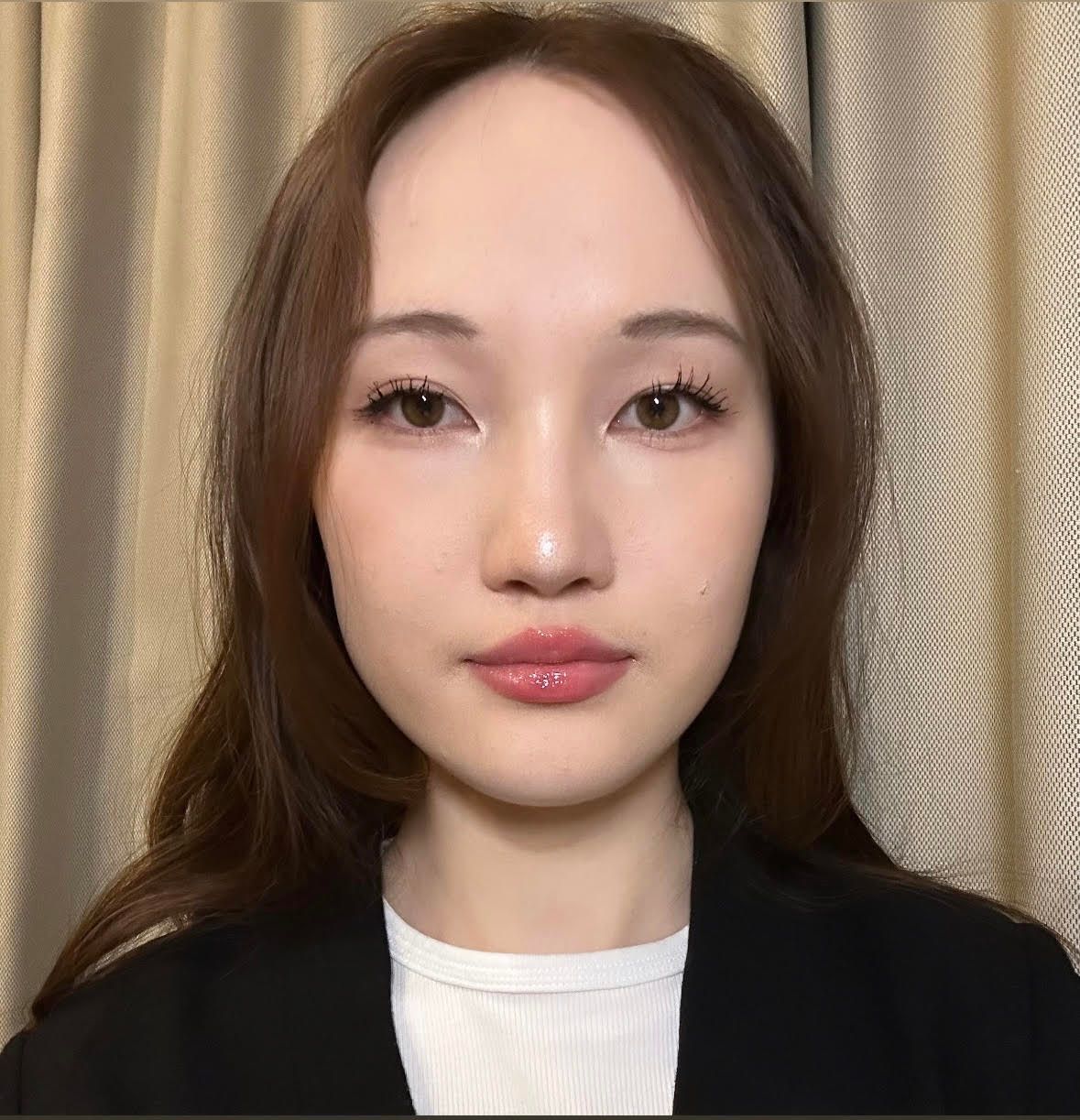
On most mornings in Almaty, Kazakhstan, the mountains disappear. The city sits in a bowl ringed by the Tian Shan peaks, but a persistent layer of smog erases them so completely that newcomers sometimes doubt they were ever there. For most residents, the haze has long since become wallpaper — unremarkable, unavoidable, normal. For Assiya, a high school student at Nazarbayev Intellectual School of Science and Mathematics, it became a calling.
"I remember how, about a year ago, Almaty was ranked the top city with the world's most polluted air," she says, with the kind of matter-of-fact gravity that suggests she has said it many times — to friends, to teachers, to anyone who will listen. "And this is why I became determined to focus all my work throughout high school on that issue."
The shift, when it came, had a face: her mother's. Allergic and sensitive to air quality, her mother would sneeze and cough through Almaty's worst days, a daily reminder that the smog was not abstract. Rather than resign herself to it, her mother began making changes — sorting recyclables, driving across the city to find the rare bins that would take them, rethinking the family's habits one practice at a time, even when no neighbours followed suit."My mother finds energy to do all these things, even when others don't. I realised: I shouldn't wait for others to step up when I can be the one who speaks up."
That image of a single person acting without waiting for permission or company settled into Assiya's thinking and would resurface years later when she was trying to understand why she herself kept hesitating. The turning point arrived in 8th and 9th grade, when Assiya began reading about young people who were already doing things: cleaning local waterways, converting air pollutants into ink, launching apps to track ecological damage. She was stunned. She tracked one of them down and asked, simply, how. The answer she got was vague: "Find the problem that concerns you, and just do it." In retrospect, however, she thinks that vagueness was the point. "The biggest life lessons happen when you figure things out yourself, not when everything is given to you on a platter."
She spent a year in that figuring-out phase. She read widely. She sat with the question of what, exactly, concerned her most. The answer, when she landed on it, was not surprising: air. The smog she had breathed every day. The mountains she could not always see. The invisible particulates her mother's lungs rejected. "If not now, when?" she remembers thinking. She started with a small chemistry project at school. That was enough of a foothold.
At fourteen, she co-developed an eco app designed to teach children about waste recycling through interactive games — grounded in the insight that young people absorb information better through play than through lectures. The same year, she joined the Junior Academy of the New York Academy of Sciences, finding herself, at fourteen, the youngest member of her team and somehow also its lead researcher, learning about bioreactor systems in real time and trusting that momentum would carry her through what preparation had not yet given her.
The momentum held. She was later selected as one of the IRIS NextGen Scholars — a competitive full scholarship that places students with university researchers for six weeks of intensive work. Assiya spent those weeks studying environmental epigenetics, specifically how early-life exposure to PM2.5 air pollutants during key developmental windows may affect cognitive function later in life. The research was dense, the timeline punishing. "I would spend every day analyzing papers, and there were so many terms I was unfamiliar with. But I learned them in six weeks.”
Alongside her research, Assiya has become increasingly preoccupied with what she calls normalization, meaning the psychological process by which a chronic crisis fades into background noise. She watched it happen with air pollution in her own city when the smog became part of the scenery, something to complain about and then ignore. She heard it in her classmates' voices when they shrugged at climate statistics. "Most people are not taking action. We're just living the way we lived, acting like nothing is happening, although we are inhaling invisible toxins in our lungs."
Normalization, in her view, is not apathy. It is a failure of imagination dressed up as realism. People convince themselves that only governments or large institutions can solve large problems, and so they wait, and waiting becomes a habit, and habit becomes identity. The counter to it, she argues, is not grand individual heroism but the steady accumulation of small, committed acts: starting an eco club, conducting a school survey, writing to a local official, choosing to recycle even when the bins are inconveniently far.
Her vision for the near future reflects this belief in scalable small actions. She wants to develop programmes teaching sustainable agricultural practices to farmers while also bringing basic waste-sorting literacy to teenagers and business owners. The eco app she built at fourteen was a proof of concept. The research she did at sixteen on PM2.5 is the scientific foundation. What comes next, she says, is implementation: moving from understanding the problem to reshaping how communities actually live inside it.
"Air pollution has shaped me so much," she says. It shaped her choice of subjects, her research focus, her career ambitions, and the texture of her daily social life. What she has also found, through this years-long process of self-discovery, is a clearer picture of how she thinks. She is a problem-solver by naturem but she has learned to slow down before solving. "I realised I tend to jump straight into solutions," she says. "So if I want to come up with a good solution, I have to spend enough time exploring the problem, understanding the root causes." It is the kind of self-knowledge that takes most people much longer to acquire, and she arrived at it not through instruction but through the friction of doing real work under real pressure.
Her advice to young people is to "Just go for it. We doubt ourselves. We immediately jump to assumptions that we’re going to fail. But you never know unless you try. If you have a project idea, or if you wanted to apply to a scholarship, just go for it. No matter how competitive it will be, or how challenging the journey is, start. Time is not an infinite resource. Young people have so much potential. Please, just try."
Jerhan Duran, Speech Category Winner — Climate Cardinals x ChallengeUS Future Leaders Competition
[Photo/Courtesy of Marat]
